
Our Production
We wanted to return to the craft of carpet knotting itself, which reaches back more than 3,000 years. Our carpets are produced in the most traditional way. They are oriental and hand-knotted. What we do differently is make each carpet to order, in a contemporary design drawn for that client. Though many people don't realize it, every step of production is done by hand.
We divided the whole production process into 10 different crafts. Each craft has its own short film. Hover over an image, or tap it on a phone, to play it.
1. Design Process
Getting a design right takes a long time: it has to be genuinely new, and still calm enough to live with for decades. The designs are difficult to weave, and that is deliberate: they push the knotters to the edge of what a loom can do, aiming at a beauty not everyone will agree on. We call it aiming for legendary.
2. Hand Carding
After the wool has been carefully selected, it is then hand carded. Carding disentangles, cleans and intermixes the fibres to produce a continuous woollen thread with well spread variations in natural colour tones. It breaks up the locks of the woollen fibres and then aligns the individual fibres to be parallel with each other. A machine carder produces a single, uniform tone. A hand carder leaves the variation in, and that variation is what you see in the finished pile.
3. Hand Spinning
After hand carding, our wool is handspun. The natural irregularity of the thickness in the handspun thread is what makes each rug unique: when soaked in dye, handspun yarn absorbs less where it is spun tightly and more where it is spun loosely. Without meaning to, the spinners have created yarn that, when dyed, is never uniform in colour. That's what creates the beauty of our rugs.
4. Dyeing
After being hand-carded and hand-spun, our yarns are dyed, by attaching the skeins of yarn to a wheel. This wheel goes through a large boiler with a boiling mixture of water, dye and binding agent. Because this is done by hand, the yarn absorbs dye unevenly. This results in subtle colour differences in the yarn.
5. Hand Knotting
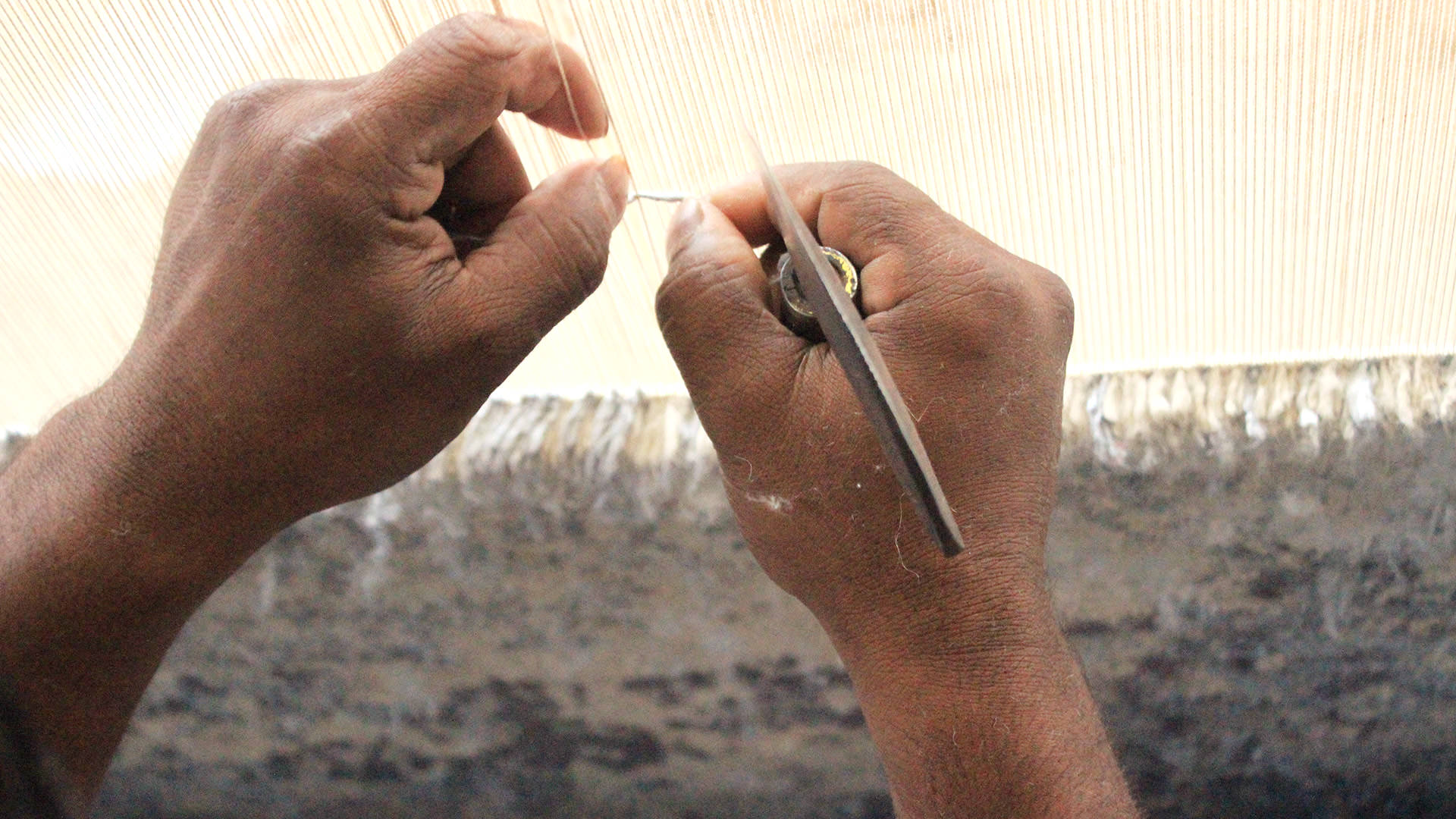
The dyed yarns are gathered at the loom. Several knotters work side by side, knot after knot, to complete the design into a whole: four to five months at our standard density, eleven months or more at the finest densities we work in. They follow a plan on graph paper where each square represents a knot. It's comparable to a computer screen, where each pixel represents a knot that is part of the composition of the design.
6. Washing
Our washers splash the rug with lots of water and mild soap and go over it with paddles. This makes the rug more supple and helps the soap bring out its sheen and luster.
7. Drying
The rug is then dried on the roofs of the many buildings around the washing area. It stays an extra 2 days in the sunlight, which deepens that sheen further.
8. Shaving
After being dried, the rug is shaved to a normal pile height. The shaving machine is held by hand, which makes this technique quite a tricky process as the exact same pressure should be applied everywhere so the pile height is identical all over the rug. Should anything go wrong, the carpet is lost.
9. Stretching
The carpet is then stretched on a metal or wooden frame, where it stays for a few days to ensure it is perfectly straight.
10. Handcarving
The last step is handcarving. During this process the background part of the design is cut out by hand with scissors. A team of craftsmen does this, and it is what gives the design its relief and its depth. We carve deeper and finer than this technique is usually taken, so the detail in the drawing carries through into the pile. People with no knowledge of rugs can hardly believe everything we do is done by hand. But it is. We are aiming for legendary.