

Interior Design
Dark Floors vs Light Floors: Which Rugs Work Best
September 1, 2026·By Thibault Van Renne·3 min read
I've spent 20 years working with hand-knotted rugs. When people ask me what makes them different from machine-made or tufted rugs, my answer is always the same: the difference isn't subtle. It's night and day.
A hand-knotted rug starts with a loom: a vertical frame strung with warp threads, usually cotton. A weaver sits at the loom and ties each individual knot of wool or silk around pairs of warp threads, then cuts the yarn by hand. After each row of knots, horizontal weft threads are passed through and the row is beaten down with a comb.
That's it. No machines and no glue anywhere in the process. Just a weaver at a loom for thousands of hours.
Our rugs are knotted by skilled artisans in India and Nepal. A standard 3×4 metre rug typically takes around 6 months. A particularly fine piece at very high density can take up to 10 to 12 months. Knot density across our collections ranges from around 125,000 to 350,000 knots per square metre.
Hand-tufted rugs are often confused with hand-knotted, partly because the name sounds similar. But the process is fundamentally different. A tufting gun punches yarn through a pre-made canvas backing. The loops are then sheared to create the pile surface. Because the yarn isn't structurally tied to anything, the whole piece is held together by a layer of latex glue applied to the back, then covered with a fabric backing to hide it.
That latex degrades. Over 10 to 15 years, it dries out, cracks, and the rug begins to shed chunks of backing material. You'll find white powder underneath it: that's the glue breaking down. There's no fixing this. It's a structural failure built into the product.
A hand-knotted rug has no glue whatsoever. Every knot is a physical connection between the pile fibre and the foundation. How long it lasts depends on how hard it is used: 20 to 30 years in a room that sees daily traffic, considerably longer in a quieter space. Kept with care, a hand-knotted rug passes to the next generation.
Machine-made rugs are produced on power looms in a fraction of the time. They use synthetic fibres (polypropylene, nylon, polyester) and can replicate patterns at high speed. A rug that takes our weavers six months can be machine-produced in hours.
But the materials have no character. Synthetic fibres don't age well: they flatten, they pill, they don't take light the same way wool and silk do. A machine-made rug typically lasts 5 to 10 years in a busy household before it looks worn out.
The simplest test: flip the rug over. On a hand-knotted rug, the pattern is clearly visible on the back, almost as sharp as on the front. Each knot shows through. On a tufted rug, you'll see a fabric backing, usually a beige or white cloth glued over the latex. On a machine-made rug, the back looks uniform and mechanical.
Then look at the fringes. On a genuine hand-knotted rug, the fringes are the natural extensions of the warp threads; they're part of the rug's structure. On tufted and machine-made rugs, fringes are sewn or glued on as decoration.
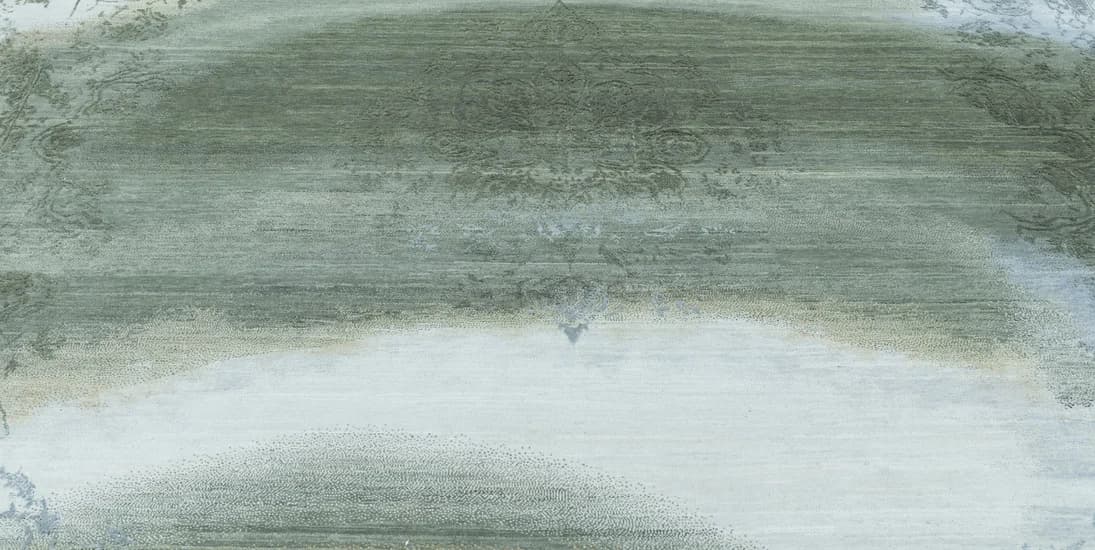
One thing people sometimes notice on a hand-knotted rug is slight colour variation within the same tone: a soft green that shifts slightly warmer or cooler across the field. This is called "abrash," and it comes from the hand-spun yarn meeting the dye bath. The thread takes colour unevenly: denser where it is tightly spun, lighter where it is loose, so no two batches are identical.
Abrash is not a defect. It's a natural result of that process, giving the rug a depth and movement that flat, machine-dyed colour doesn't have.
Every TVR rug is made with hand-spun wool and natural silk. We design in our studio in Ghent, then work directly with our knotting ateliers in India and Nepal. Our production is Care & Fair certified: independent audits ensuring no child labour, fair wages, and funding for education and healthcare in knotting communities.
We don't cut corners on materials or time. A rug that takes six months to make and uses the finest hand-spun wool is simply a different product from one made in six hours from polypropylene. That difference is in the material itself, not in the way we describe it.
If you want to see and feel the difference yourself, visit our showroom in Evergem or contact us.

