

Care & Maintenance
Can a Damaged Hand-Knotted Rug Be Repaired?
October 19, 2026·By Thibault Van Renne·3 min read

Step into one of our weaving ateliers at dawn and the first thing you notice is the silence. No engines, no fans, no mechanical rhythm. A low wooden loom lit by a single shuttered window. Two master knotters taking their places on a plank, balls of hand-spun wool at their feet. A cartoon pinned to the warp. Somewhere in the courtyard, skeins of newly dyed yarn drying on a rope.
A hand-knotted rug is not assembled. It is grown, knot by knot, over many months. In our atelier we still follow the slow sequence our craft has followed for centuries: select the fibre, dye it, string the loom, tie each knot by hand, wash, stretch, clip, and inspect. Nothing is accelerated. Nothing is outsourced to a machine. What follows is the honest map of how one of our pieces is made, from the first fleece to the final check on the Evergem floor.
Everything begins with the fleece. We work almost exclusively with highland wool from cooler latitudes, where the animals grow a longer, lustrous staple that takes dye beautifully and resists crushing under decades of use. The finest of our wools are hand-spun on a charkha in Rajasthan, which leaves a subtle variation in the thread that no industrial spindle can reproduce. That small irregularity is what gives a TVR rug its depth under light.
Our natural silk is mulberry silk, and only mulberry silk, never a relabelled viscose. Part of it is hand-reeled in Kashmir; another part comes to us as raw silk from Bangalore, at a grade normally reserved for high-couture clothing. We buy that raw material and have it spun in-house, by our own artisans, so that it can be used in carpets rather than cloth. That step is one almost no other rug house takes, and one of the quiet reasons a TVR piece feels the way it does under the hand. Our warp is long-staple cotton, chosen for dimensional stability. If you want to feel what that does to a surface, ask to see our wool-led Kashmir collection, woven in Rajasthan.
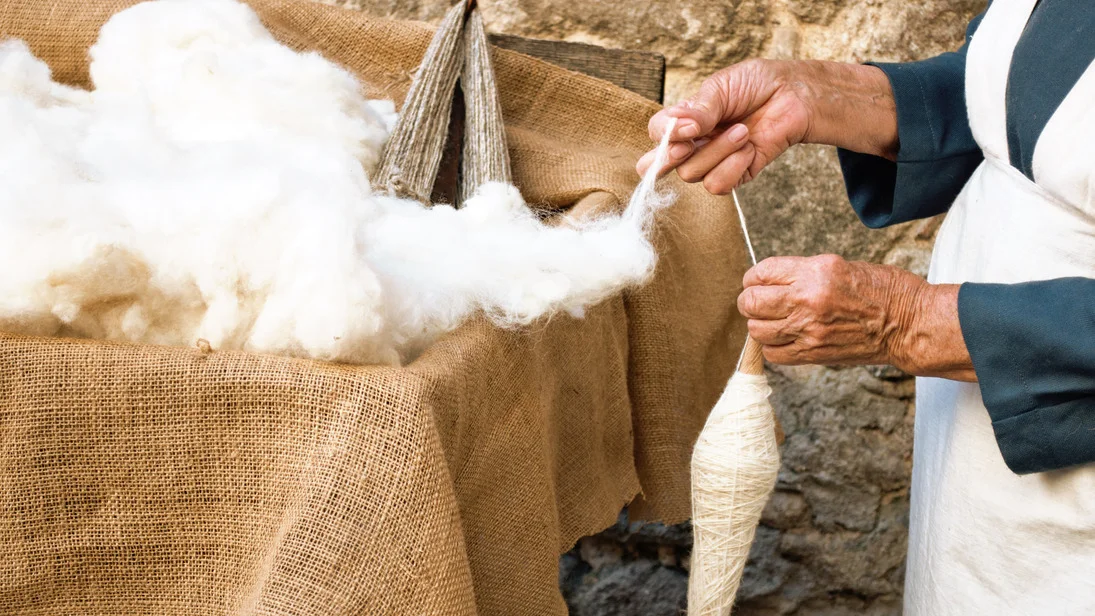
Hand-spinning wool on a charkha in Rajasthan.
Before a single gram of fibre enters production, each bale is opened in daylight and graded by hand. Length, crimp, lustre and cleanliness are assessed against reference samples kept in our studio. A bale that does not match the reference is rejected, no matter how well it measured on paper. A rug is only as long-lived as the staple it begins with, and we would rather delay a commission by a season than compromise on the fibre that will support it for decades.
Wool, natural silk, bamboo silk and nettle each behave differently under light and under feet. We describe them one by one on our materials page.
Colour, in a true hand-knotted rug, is never printed on top. It is cooked into the fibre. Our yarns are dyed with Swiss chemical dyes, applied with our in-house technique in small copper vats, each batch logged against a master reference skein. We dye enough yarn for one rug in a single session, because even within a carefully controlled process, two hand-dyed batches are never truly identical.
That is also the secret behind abrash: the gentle tonal drift you see across a hand-knotted field. It is not a fault. It is the result of small hand-dyed lots and hand-spun yarn, where each skein takes the colour a fraction differently. We judge consistency against the master skein and by eye, not by spectrophotometer reading.
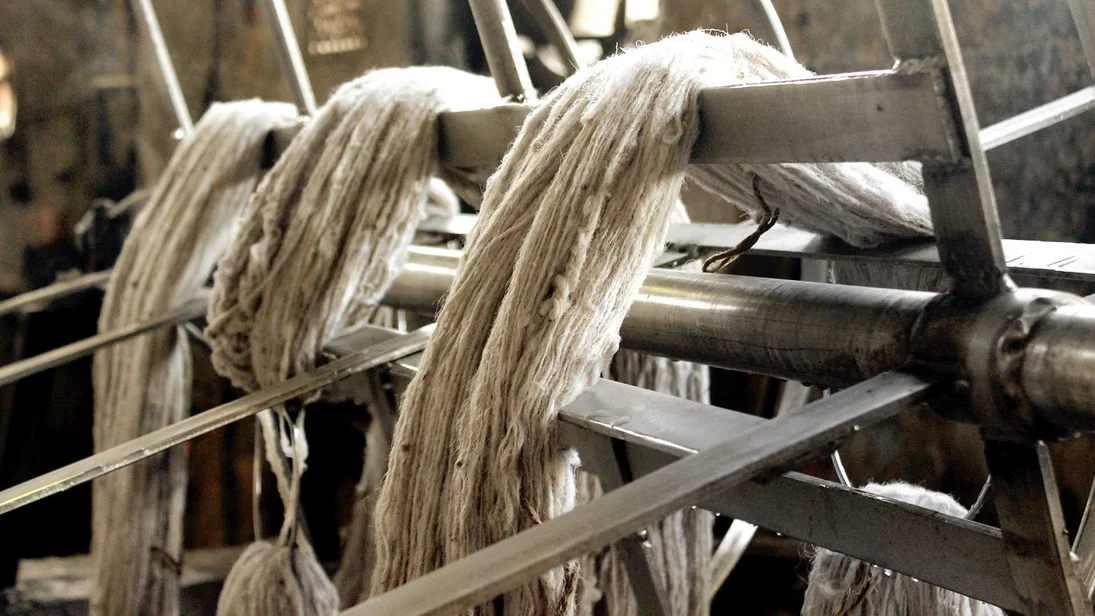
Small-batch dyeing in copper vats: one rug's worth of yarn per session.
After dyeing, every skein is sun-dried, rinsed a second time in clean water, and cured on open racks before it is allowed near a loom. We keep cutting samples from each dye lot, clipped to a master card that travels with the rug from the first knot to the final inspection in Evergem. Years later, when a client returns to commission a companion piece, that card is still in our archive, which is how we can match tone with confidence a decade after the first rug was delivered.
Before a single knot is tied, the loom itself must be dressed. A full-width rug can require several thousand warp threads, each one tensioned by hand along the vertical beams. Our setters walk the loom back and forth for a full day or more, counting, combing, adjusting. If the tension is uneven by even a small margin, the finished rug will never lie flat.
The cartoon, a full-size colour-coded plan of the design, is then fixed behind the warp. From this moment on, the master knotters are reading music. Every square on the cartoon corresponds to a single knot on the rug.
For curved pieces, runners that turn a corner, or L-shaped rugs that follow an architect's drawing, the warping stage becomes even more demanding. We map the geometry onto the loom with chalk and plumb-line, and a single senior hand supervises the setting from beginning to end. It is slow, meticulous work, and it is the only way to produce a non-rectangular rug that still hangs true years later.
The knot is where a rug reveals its lineage. Every hand-knotted rug in the world is built from one of two structural knots: the symmetric knot, traditionally called the Turkish or Ghiordes knot after the Anatolian town of Gördes, and the asymmetric knot, traditionally called the Persian or Senneh knot. A third technique sits outside that binary: the Tibetan loop knot, tied with a gauge rod and cut row by row, developed independently in Tibet and used today almost exclusively in Nepali and Tibetan-heritage workshops.
The trade names are imprecise. The rugs actually woven in the town of Senneh (modern Sanandaj, in Iranian Kurdistan) are tied with the symmetric knot, not the asymmetric one that carries the town's name in the West. Cecil Edwards flagged this in The Persian Carpet in 1953, and every serious reference since has followed his lead in preferring the structurally accurate terms symmetric and asymmetric.
In our houses we weave in two of these traditions.
Density follows the design. A bold contemporary piece in pure wool may sit at 120,000 knots per square metre. A classical wool-and-silk medallion rises to 200,000 to 300,000. The finest pure-silk atelier pieces we weave in Rajasthan reach up to 350,000 knots per square metre, and at that density the drawing resolves the way a photograph does. We do not weave in Kashmir; what comes to us from Kashmir is raw silk, hand-reeled there, which then travels to our Rajasthan atelier to be tied into carpets.
Between knot and density lies a whole grammar of possibilities. An asymmetric knot in long-staple highland wool gives a grounded, almost architectural surface; the same knot in silk lets a single fine line travel across the field without blurring; a Tibetan knot in a gently carved pile turns a graphic drawing into something closer to sculpture. When we draw a new design in our studio, the first conversation is rarely about colour. It is about which knot and which density will let the drawing breathe. That choice is made once and it shapes everything that follows for the next year.
What does that actually mean in months? A few honest numbers from our own production:
We never compress these timelines. A rug that is hurried will hold for a decade and then start to come apart, the pile buckling and the knots working loose. Our finest Rajasthan silk work, closer to jewellery than to soft furnishing, is offered through the Savonnerie pieces in our Limited Editions.
When the final knot is tied, the rug is cut from the loom and sent to the washing ghat. It is submerged, rinsed, and beaten with flat wooden paddles to open the fibre and lock the knots. A careful sun-cure lifts the natural lustre of the wool; silk is washed more gently and dried in the shade.
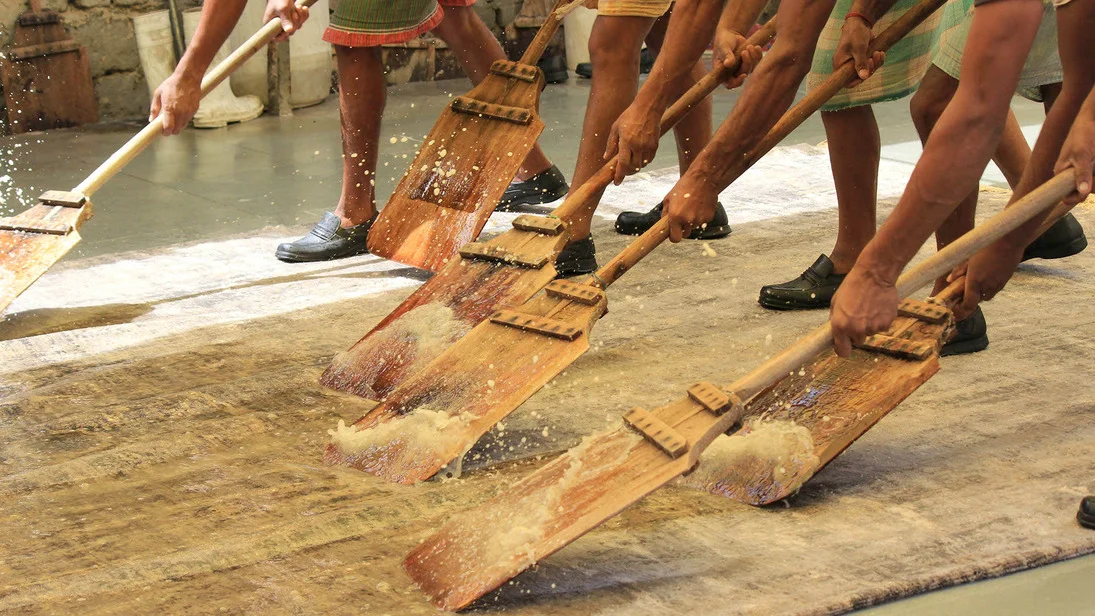
Washing the rug at the ghat: water passes cleanly through a glue-free structure.
Next, the rug is stretched on a tenter frame for several days so that the geometry settles. Then the clippers arrive. They trim the pile by hand, sometimes at different heights to sculpt the drawing, leaving a surface that catches light precisely the way the designer intended. Only now does the rug begin to look finished.
Hand-clipping is a discipline in itself. Our senior clippers train for years before they are allowed to work on a fine silk piece; their scissors follow the edges of a motif the way a sculptor follows the grain of stone. On a carved contemporary design, this stage alone can add three to four weeks to the timeline, and we build it into the planning without compromise.
Every TVR rug travels from the atelier to our workshop in Evergem before it ever meets a client. There, the final quality inspection is carried out by our own hands. We check knot count against specification, measure squareness to the millimetre, look for any dye shift outside tolerance, examine the selvedges and fringes, and walk the full field under daylight and raking light. If a rug does not satisfy us here, it does not leave Evergem. A small number of pieces each year are returned to the atelier for rework. That is the discipline that keeps the name honest.
This final stage is also where the rug is photographed and logged against its commission file, along with the dye reference card, the original cartoon and a recorded set of measurements. The archive will outlast us. If, in thirty years, a client or their heirs ask us to restore a rug that was once made in this house, the file we keep today is what allows us to answer that request with precision rather than with approximation.
If you would like to see each of these stages on film, our production tour walks through the whole sequence with photography from our ateliers.
How long does a hand-knotted rug actually take to make?
Between 2 and 10 months for most pieces, depending on size, knot density and fibre. A typical TVR commission in the 3 × 4 m range is delivered 6 to 10 months after the design is signed off. Exceptionally large commissions (a rug of 17 × 9 metres, for example) can take 12 to 14 months.
Can I commission a rug in a non-standard size or shape?
Yes. Every rug we make is woven to order. Round, oval, L-shaped, or curved to follow a staircase, the price per square metre does not change with the shape. It does change with certain very large sizes: beyond a given dimension, wider looms, larger weaving teams and extra handling add a per-square-metre premium, which we share with you in writing before you commit.
How is a hand-knotted rug different from a machine-made one?
A machine-made rug is woven on a power loom, and a hand-tufted rug is punched into a canvas backing and held together by latex glue. A hand-knotted rug has no glue at all; every fibre is mechanically tied into the foundation. With care, ours outlive the room they were made for. The difference shows in daily life as well. A hand-knotted rug has a direction of weave, so the pile reads lighter from one side and deeper from the other, and it plays with the light as you walk around it. It behaves beautifully over heated floors, because no adhesive blocks the warmth. It can be washed by running water rather than only surface-cleaned, because liquid passes cleanly through a glue-free structure. And it folds, ships, stores and comes back to life far more easily than a backed rug, which is why our pieces travel the world without damage.
How should I care for it?
Rotate the rug once a year, vacuum gently without a beater bar, and address spills with a dry cloth before reaching for water. A professional hand-wash every 3 to 5 years is usually enough.
The loom, the knot density and the fibre are choices, not accidents. They follow from the way we think about the craft, which we set out on our Craftsmanship page.
If you are considering a commission for your home or a project, write to us and we will take it from there.

