

Interior Design
Dark Floors vs Light Floors: Which Rugs Work Best
September 1, 2026·By Thibault Van Renne·3 min read
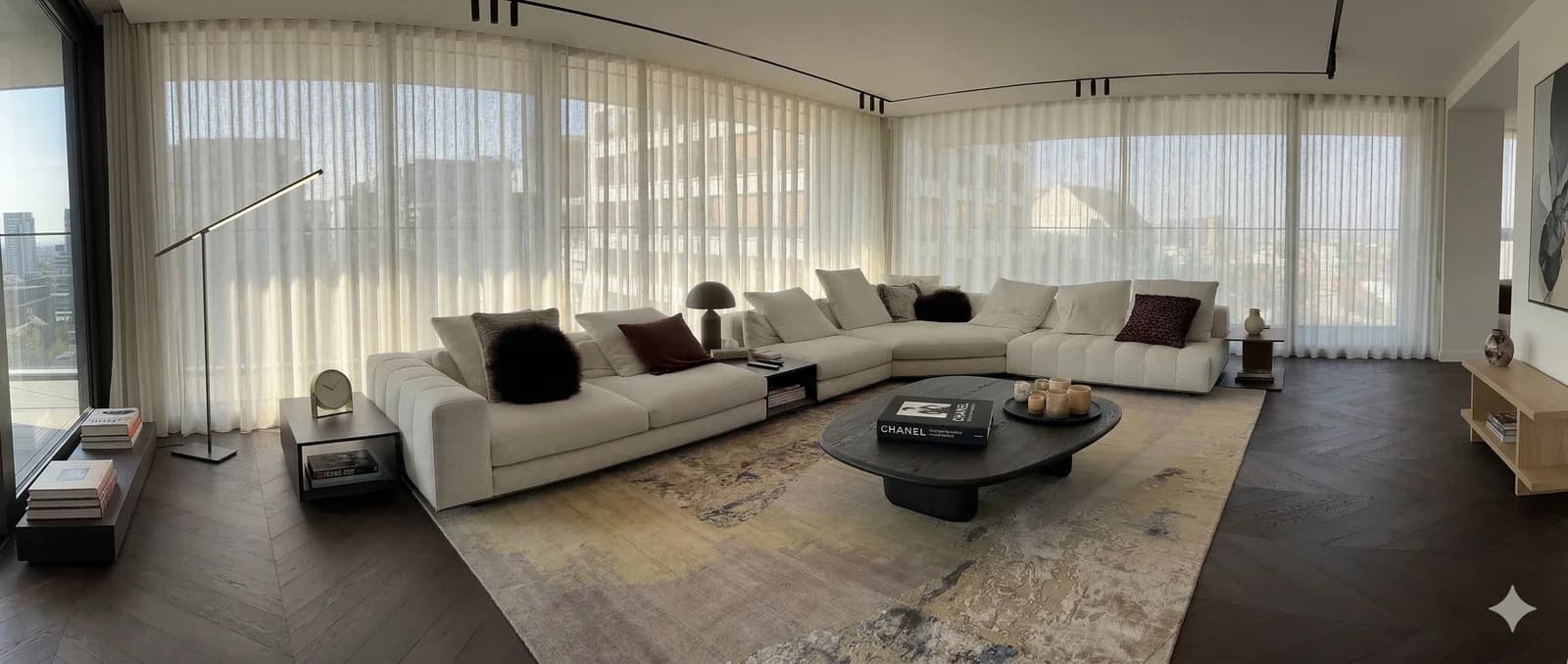
The most common mistake I see? A rug that's too small for the room.
After 20 years designing rugs for residential and hospitality projects around the world, I can tell you that size is the single most important decision you'll make when choosing an area rug. A beautiful design in the wrong dimensions will look off, every time. Get the proportions right, and even a simple design will sit properly in the room.
Here's how I guide my clients through sizing, room by room.
This sizing logic is unchanged for 2026, and it now sits alongside a dedicated guide to round and custom-shaped rugs for spaces a standard rectangle does not fit.

In a living room, all furniture legs should sit on the rug. Full stop. The sofa, the armchairs, the coffee table: everything anchored on one surface. This pulls the seating arrangement together and makes the space feel deliberate.
If your room doesn't allow for that, the minimum is front legs on the rug. But never let all four legs of a sofa float off the edge. It looks like the rug was an afterthought.
For most living rooms, this means an area rug of at least 240 x 300 cm. Larger rooms: 300 x 400 cm or more. Leave 20 to 30 cm of floor visible between the rug edge and the wall. A rug that runs wall-to-wall without actually being wall-to-wall carpet looks like a mistake.
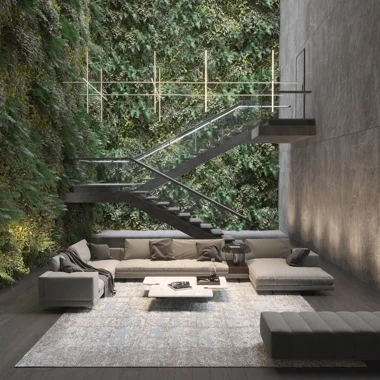
An oversized rug grounds the living room, the Legends and Flows collections are crafted in large formats for exactly this register.
For a dining table, add at least 75 cm on each side of the table. That's not a design preference; it's functional. When someone pushes their chair back, the rear legs need to stay on the rug. If they don't, the chair catches the edge, and over time, that constant dragging damages both rug and chair.
A table that seats six typically needs a rug of at least 300 x 350 cm. For eight, plan for 350 x 400 cm.
For dining, clean geometric registers read best, see the Elegance and Spaces collections.
A bedroom rug should extend 60 to 90 cm beyond the sides and foot of the bed. When you step out of bed in the morning, your feet should land on the rug, not on cold floor. The rug can tuck partly under the bed; that's fine and expected.
For a standard king-size bed, a rug of 300 x 350 cm works well. If the bedroom is generous, go larger.
In the bedroom, silk softens everything, the Kashmir and Mystique collections are woven in pure silk and wool-silk blends.
Hallways need custom runners. The width should leave 10 to 15 cm of floor visible on each side. This framing effect makes the runner look intentional. A runner that's too wide for the hallway looks forced; too narrow, and it looks like a leftover.
Length depends on the corridor. We weave runners to any length. 2 metres or 12 metres, the price per square metre stays the same.
In open-plan spaces, area rugs do the work that walls used to do. A rug under the dining table defines the eating area. A different rug under the sofa group defines the lounge. The space reads as one room with distinct zones, not a large empty floor with scattered furniture.
Choose rugs that complement each other without matching exactly. Same colour family, different patterns, or the reverse.
Before you commit to any size, do this: take painter's tape and outline the rug dimensions directly on your floor. Live with it for a day. Walk around it. Sit in your chairs. Move them in and out.
The tape costs nothing and takes five minutes to lay out. It spares you the real expense: ordering a rug in the wrong size.
Don't guess. Tape it out.
When clients are torn between two sizes, I tell them to go with the larger one. An oversized rug makes a room feel grounded and generous. An undersized rug makes the same room feel smaller and fragmented.
There is no standard that says a rug must be a certain size. At TVR, every rug is woven to order, in whatever size your room asks for. Any width, any length, any shape: round, oval, L-shaped, or curved to follow the architecture of the room. Custom dimensions don't cost extra per square metre.
If you prefer a classic design at the scale of your room, our French Savonnerie rugs are woven to order in the same way.
If you're unsure about proportions, send us your floor plan and we'll advise on the right dimensions for your space.
Send your floor plan, we reply within 24 hours with tailored sizing advice.
Any width, any length, any shape, woven to the architecture of your room.
Start with the function. In a living room, the rug should be large enough that all sofa and armchair legs sit on it, front legs at minimum. Under a dining table, allow at least 75 cm on each side so chairs stay on the rug when pushed back. In a bedroom, the rug should extend 60 to 90 cm beyond the bed. When in doubt, choose the larger size, undersized rugs are the most common mistake.
Send your floor planFor a standard living room, plan for at least 240 × 300 cm. Larger rooms call for 300 × 400 cm or more. A six-seat dining table needs 300 × 350 cm; an eight-seat table needs 350 × 400 cm. A king-size bedroom rug is typically 300 × 350 cm. Every TVR rug is woven to your exact dimensions, with no surcharge for non-standard sizes.
Discuss a custom sizeAim for an area rug large enough that the sofa and armchairs all sit on it. If that is not possible, the front legs of every seating piece must rest on the rug. Most living rooms work with 240 × 300 cm; generous rooms call for 300 × 400 cm or larger. Leave 20 to 30 cm of floor visible between the rug edge and the wall.
Browse living-room collectionsA bedroom rug should extend 60 to 90 cm beyond the sides and the foot of the bed, so your feet land on wool and not on cold floor. For a standard king-size bed, 300 × 350 cm works well. The rug can tuck partly under the bed, that is expected and looks correct.
Browse bedroom collectionsIn a living room, ideally yes, all sofa and armchair legs on a single grounded surface. If the room does not allow it, the absolute minimum is the front legs on the rug. Never let all four legs of a sofa float off the edge: it makes the rug look like an afterthought rather than the foundation of the room.
Get sizing adviceYes. Every TVR rug is hand-knotted to your exact dimensions, any width, any length, any shape: rectangular, round, oval, L-shaped, or curved to follow your architecture. Custom sizes do not cost extra per square metre. Production runs eight to fourteen weeks depending on the collection and complexity.
Discuss a custom rug
