

Care & Maintenance
De complete gids voor het stofzuigen van een handgeknoopt tapijt
29 september 2026·Door Thibault Van Renne·3 min lezen
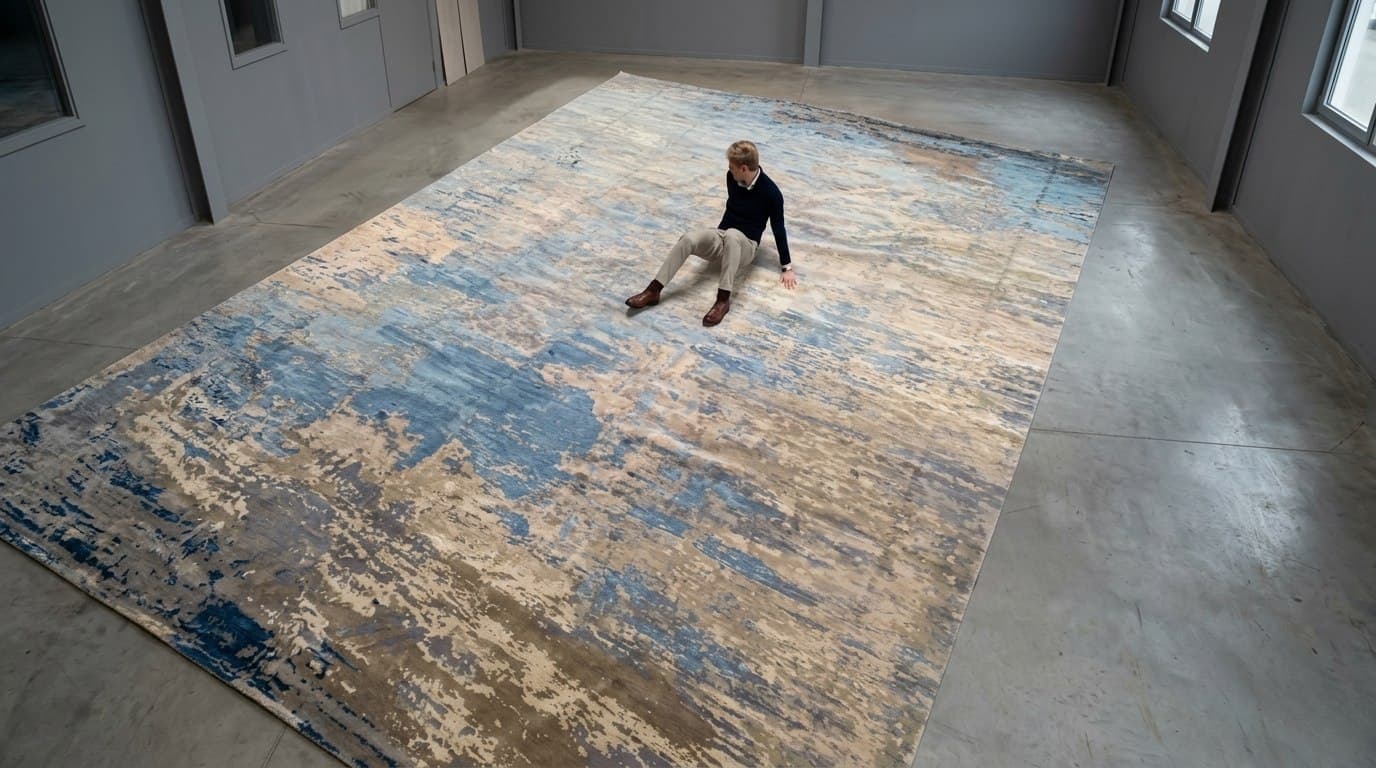
The question arrives in my inbox weekly. People want to know whether a hand-knotted rug can compete with stocks, bonds, or property. My honest answer: I don't know what markets will do, and neither does anyone else. What I can tell you, after twenty years in this world, is that these rugs are getting harder to make, and that the largest ones will be the first to go.
I want to be clear: I would never encourage someone to buy one of our pieces purely as a financial investment. That's not what we make them for, and the rug market is far too opaque to predict with any confidence. But I do believe that certain pieces (particularly large-format works) will become extraordinarily difficult to source in the years ahead. Whether that translates into monetary appreciation, I can't say. That they will become genuinely irreplaceable, I can.
The people who can weave at this level are disappearing, and almost no buyer sees it happening. The master weavers who can execute a 5×7 metre carpet at the finest densities, holding a complex design in their heads across months of work, are ageing. Their apprentices are fewer. Easier, better-paid work keeps pulling the next generation away.
A rug of that scale requires a weaver to commit twelve to eighteen months of their life to a single piece. That kind of dedication, at that level of skill, is becoming rarer every decade. We work with around 500 weavers across our workshops in Nepal and India, and we are acutely aware that the pipeline of people capable of the most demanding formats is contracting.
I am not saying this to sell anything. The largest and most technically complex pieces being made today may not be reproducible in twenty years. The designs will survive. The hands able to execute them will not, at least not in the same numbers.
What a rug will still be worth in thirty years starts with what it was made from. Hand-spun wool is irregular in a way machine-processed yarn is not. It catches light differently, and it ages into something better rather than just wearing down. Natural silk, used selectively in our pieces for highlights and detail, gives a depth that synthetic pile does not have.
Provenance matters too, and not in a marketing sense. A piece with documented workshop origins, weaver information, and material specifications is verifiable. That documentation becomes more valuable as time passes and memories fade. We provide it with every piece we make, not because clients demand it today, but because someone will want it in thirty years.
Condition counts for as much as the material. Unlike a painting sealed behind glass, a rug is walked on. After two decades, a well-kept piece and a neglected one are no longer the same rug, in looks or in worth. Simple habits make an enormous difference: no beater bar on the vacuum, professional cleaning every few years, protection from direct sunlight.
One return on a hand-knotted rug needs no market prediction: the daily pleasure of living with something made by hand, at a level of skill fewer and fewer people still have. A great rug gives you something every time you walk into the room. You will not get that from a line on a statement.
I've made pieces that clients tell me have become the emotional centre of their household: the thing they'd take in a fire. That kind of relationship with an object is not transferable to most asset classes.
So: will our rugs appreciate financially? Perhaps, for the largest and rarest pieces, as the craft contracts. But that's not the promise we make. The promise is a rug made by hand, from materials that age well, by weavers whose skill gets harder to replace every year.
Contact us or visit our showroom in Evergem, Belgium.

